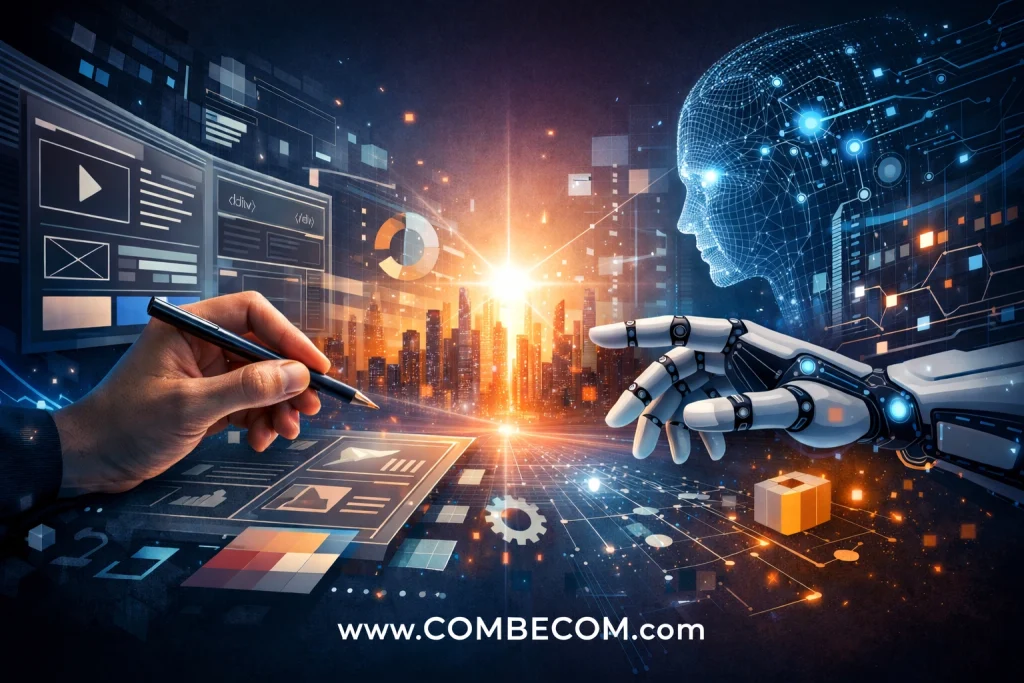
The future of web design is no longer about tools alone — it’s about how AI and human expertise intersect.
An Engineering Background Shaping How I See the Web
My name is Benyamin.
My academic background is in Civil Engineering, with a master’s specialization in Earthquake Engineering. For years, I was trained to understand why structures stand, why they shake, and under what conditions they fail. Load analysis, stability, resilience, and structural behavior under stress were not abstract concepts for me — they were part of how I learned to think.
From Structural Analysis to Digital Systems
Alongside this engineering path, I developed a deep passion for coding, web development, website design, SEO, and optimization. What started as curiosity gradually became my professional direction.
For nearly two decades, I’ve been actively working on the web — writing code, working with different systems, designing, optimizing, and analyzing websites across various scales and use cases.
From the very beginning, I never saw a website as just a visual interface.
Instinctively, I approached it as a structure
When Web Design Was Manual Bricklaying
In the early days, web design felt exactly like manual bricklaying.
You wrote HTML line by line to build the structural skeleton, added CSS to give it form and character, and used JavaScript to breathe a living, interactive presence into the site. It was slow, yes — but it had a crucial advantage:
we knew exactly what every line of code did, and why it existed where it did.
Understanding Every Load-Bearing Line of Code
Building a website felt like placing bricks by hand, one at a time, with care.
The structure grew gradually, but you understood every load-bearing point.
When AI Entered the Construction Site
Then AI-powered tools entered the picture.
Suddenly, speed increased dramatically. In one project, an AI system proposed a complete structure in minutes — something that used to take hours. The framework was there, the layout looked solid, even the visuals felt polished.
Speed Without Structural Awareness
But in that moment, a familiar engineering question surfaced in my mind:
What kind of load is this structure designed for?
AI had no understanding of:
- how much traffic the site would need to handle,
- how it should behave under peak demand,
- the mindset users would bring with them,
- or how the system should respond if one component failed.
That’s when it became clear to me:
the problem wasn’t speed.
The problem was that machines can assemble structures, but they don’t understand load, stress, or behavior.
Websites as Structures, Not Pages
From that point on, my engineering perspective on web design fully crystallized:
A website is a structure
SEO is progressive load-bearing
Security is stability
Performance is dynamic response
Scalability is resilience
Why Human Judgment Still Defines the System
AI can bring the bricks.
It can raise the walls.
It can even suggest ready-made blueprints.
But it still doesn’t understand who the structure is built for,
or under what conditions it must endure.
And that led me to a clear conclusion:
AI has transformed execution —
but responsibility for decisions remains human.
SEO in the Age of AI and User Intent
For a long time, SEO felt like solving a technical puzzle.
If you followed enough rules, repeated the right keywords, and optimized enough pages, results usually followed.
I lived through that era.
When SEO Was More About Manipulation Than Meaning
There was a time when SEO felt like reinforcing a structure without understanding load paths. You added links, injected keywords, tweaked meta tags — and sometimes it worked.
But just like an over-reinforced structure without proper analysis, something always felt fragile.
Everything changed when AI entered search.
Search engines stopped behaving like machines that simply count signals.
They evolved into systems that interpret user intent.
When AI-Generated Content Failed in Real Projects
At one point, I worked on a project where large volumes of content were produced with the help of AI.
On paper, everything looked perfect:
clean structure, consistent tone, proper formatting.
For a while, traffic increased.
Then it stopped.
The Moment Google Went Silent
Pages were indexed, but visibility slowly faded.
Rankings didn’t collapse overnight — they simply stopped growing. Google didn’t penalize the site; it ignored it.
That was the moment I realized:
the problem wasn’t surface-level quality —
the problem was the absence of real experience behind the content.
AI could generate answers,
but it couldn’t demonstrate understanding.
SEO as Progressive Load-Bearing, Not Keyword Density
From an engineering perspective, modern SEO feels very familiar to me.
You never load a structure all at once.
You increase load gradually, allowing the system to adapt.
SEO works the same way.
Why Experience Matters More Than Content Volume
Search engines now look for signals that only humans can provide:
- real-world context
- depth of decision-making
- consistency of perspective
- evidence of lived experience
This is why purely AI-generated content struggles over time.
It may match search queries, but it doesn’t carry weight.
SEO has moved beyond optimization techniques and into credibility engineering.
How I Use AI in SEO Without Letting It Take Control
I don’t avoid AI in SEO.
But I don’t hand over control to it either.
AI as an Assistant, Not the Author
I use AI to:
- analyze search patterns
- identify content gaps
- structure complex topics
- process large datasets quickly
But the narrative, judgment, and conclusions always remain human.
Because no algorithm can replace moments like realizing:
- why a page feels trustworthy
- why a user hesitates before clicking
- or why content that is technically correct still fails emotionally
Why Search Engines Reward Human-Led Content
Search engines are no longer just ranking information.
They are ranking perspective.
A page that reflects real experience sends a signal algorithms are trained to detect — but cannot generate on their own: authenticity.
That’s why SEO in the age of AI is less about tricks and more about alignment:
- alignment with user intent
- alignment with reality
- alignment with responsibility
What This Shift Means for Businesses That Rely on SEO
For businesses, this shift is critical.
If SEO is treated as content production, results will be temporary.
If it’s treated as system design — built on experience, clarity, and consistency — results compound over time.
AI accelerates execution,
but direction still defines outcomes.
Website Security: When Automation Turns Against the System
Security is often treated as a purely technical layer — something added after everything else is built.
For me, coming from an engineering background, security has always meant stability under stress, not just restriction.
And I learned this the hard way.
When Smart Security Became the Biggest Risk
In one of our infrastructure-level projects, security was critical.
We were dealing with sensitive data, high traffic expectations, and tightly controlled access. The goal was clear: build a system that could protect itself around the clock.
With the help of AI-driven security tools, we implemented an advanced setup.
On paper, it looked flawless: intelligent rules, automated responses, real-time threat detection.
Until one night, while I was adjusting server-level configurations, the system flagged me as an unknown intruder.
Within seconds, my access to the entire server was blocked.
The Moment the System Locked Its Own Builder Out
At first, I assumed it was a temporary misconfiguration.
It wasn’t.
The same security logic that blocked my access also blocked search engine crawlers.
Googlebot could no longer reach newly published pages. Monitoring tools went silent. The website was technically “secure” — but functionally isolated.
That was the moment I realized something critical:
Security without context doesn’t protect a system — it disconnects it.
Security as Stability, Not Aggression
From an engineering perspective, this failure made complete sense.
A structure designed to resist every possible force by locking itself rigidly will eventually crack under pressure.
Digital systems behave the same way.
Why Over-Automation Breaks Trust
AI-based security systems are excellent at recognizing patterns.
What they lack is situational understanding.
They don’t know:
- when legitimate access should remain possible,
- when flexibility matters more than restriction,
- or how security decisions impact visibility and trust.
Security that blocks real users, administrators, or search engines isn’t secure — it’s unstable.
The Balance Between AI Monitoring and Human Judgment
After that incident, we changed our approach.
We still use AI for:
- continuous monitoring,
- anomaly detection,
- early threat warnings.
But final authority always remains human.
Security Needs Oversight, Not Absolutes
AI can signal risk.
Humans decide the response.
This balance ensures that:
- real threats are stopped,
- legitimate access is preserved,
- and the system remains visible, indexable, and usable.
In other words, security becomes resilient, not hostile.
How Security Impacts SEO, Trust, and Performance
Many teams treat security, SEO, and performance as separate concerns.
In reality, they are tightly connected.
Overly restrictive security can:
- block search engine crawlers,
- slow response times,
- create friction for real users.
All of these quietly erode trust.
A secure website should feel open to users and search engines — not suspicious of them.
For business leaders, security decisions are not just technical choices.
They are strategic ones.
AI can help detect threats faster than ever.
But without human judgment, it can also:
- limit growth,
- reduce visibility,
- and weaken credibility.
Security should protect your system
without isolating it from the world it is built for.
Design Psychology in the Future of Web Design
AI is extremely powerful at optimizing patterns.
Where it falls short is human hesitation.
Users rarely arrive on a website ready to act.
They arrive with unspoken questions:
- Can I trust this?
- Do they understand my problem?
- Is this the right decision?
These are emotional checkpoints, not logical ones.
And this is exactly where design psychology begins — and algorithms reach their limits.
The “Grandmother Test” We Use in Real Projects
Inside our team, we follow a simple rule we call the grandmother test.
If a website isn’t understandable for the least technical, most tired, and least patient user, it isn’t ready — no matter how modern it looks.
In one project, an AI-assisted layout looked flawless on paper:
clean spacing, minimal UI, and trendy interactions.
I showed it to an older user who simply wanted to buy a gift.
After a few minutes of confusion, she looked up and said:
“I just want to buy this. Where is the button?”
The button was there.
But it was placed where an algorithm thought it should be — not where a human instinctively looks.
That moment reinforced something I strongly believe in:
clarity always beats cleverness.
When Data-Driven Design Ignores Human Reality
AI-driven decisions are typically based on aggregated behavior.
They optimize for averages.
Humans don’t behave like averages.
The Red Button That Shouldn’t Exist
In another project, AI-based testing suggested turning all primary buttons red.
The data showed higher click-through rates.
But the website belonged to a brand focused on calmness, focus, and mental clarity.
Red didn’t signal action —
it signaled urgency and stress.
We ignored the data.
Clicks dropped slightly.
Trust increased noticeably.
And conversions followed.
Design psychology is not about maximizing interaction at any cost.
It’s about creating the right emotional state for decision-making.
White Space and the Value of What You Don’t Show
One of the most common fears clients have is empty space.
They feel every section must be filled with content, visuals, or features.
AI often reinforces this instinct by suggesting more elements, more sections, more variation.
In reality, white space is one of the most powerful design tools available.
In a luxury-focused project, we removed almost everything and placed a single product at the center of the page.
No clutter. No competition. Just space.
That empty space communicated confidence, value, and restraint — without saying a word.
Algorithms try to fill space.
Humans understand when to leave it empty.
Why Empathy Can’t Be Automated
AI can analyze behavior.
It cannot experience doubt.
It doesn’t feel frustration when something is unclear.
It doesn’t feel relief when something finally makes sense.
Design decisions that build trust often come from empathy:
anticipating confusion,
reducing cognitive load,
respecting attention and focus.
These are not optimizations —
they are judgments.
For business owners, good design is not about being impressive.
It’s about being understandable.
AI can test variations, analyze behavior, and suggest improvements.
But when design decisions are made without human empathy, the result may be efficient — yet ineffective.
Trust isn’t built through interaction alone.
It’s built through clarity, comfort, and restraint.
And those qualities still come from human understanding.
Performance, Typography, and the Technical Signals of Trust
Performance is rarely perceived as a technical detail by users —
but it’s almost always interpreted as a trust signal.
Before anyone reads your content, understands your message, or evaluates your offer, something else happens first:
the website responds — or it doesn’t.
That initial response quietly shapes the entire perception of credibility.
Speed Is Not Optimization, It’s Expectation
I’ve seen visually impressive websites fail simply because they felt slow.
Not broken. Not unusable. Just slow enough to trigger doubt.
From a system perspective, speed is not about chasing perfect scores.
It’s about predictable response under pressure.
A website that loads fast once but struggles under traffic spikes behaves like a structure that looks solid — until stress is applied.
That’s when performance stops being technical and starts being psychological.
Typography Carries Weight — Literally and Emotionally
Typography is often treated as a visual preference.
In reality, it’s a structural decision.
I’ve worked on projects where fonts alone added megabytes to page weight.
The design looked refined, but the site felt heavy, unresponsive, resistant.
When we switched to variable fonts, something interesting happened:
- load times improved,
- layout stability increased,
- and the site simply felt calmer.
Users didn’t notice the font choice consciously —
they noticed the absence of friction.
Technical Decisions Users Never See — But Always Feel
No user will ever say,
“I trust this brand because they optimized font delivery.”
But they will feel:
- whether scrolling is smooth,
- whether interaction feels immediate,
- whether the interface responds without hesitation.
These sensations accumulate.
Trust is rarely created by one feature.
It’s created by the absence of resistance across the system.
Performance as Structural Integrity
From an engineering mindset, performance behaves like structural integrity.
It’s not about maximum speed in isolation.
It’s about consistent behavior under real conditions.
That means:
- controlling asset weight,
- respecting device limitations,
- and designing systems that degrade gracefully — not collapse suddenly.
AI can help optimize assets.
But it cannot decide which compromises are acceptable.
That decision still belongs to humans.
Why Performance Is a Long-Term Advantage
Fast websites don’t just rank better.
They age better.
They adapt more easily.
They scale with less friction.
They maintain trust even as complexity increases.
Performance isn’t a feature.
It’s a foundation.
And like any foundation, if it’s weak, everything above it becomes fragile.
Designing for Global Markets: When Culture Shapes UX
One of the most common mistakes I see in international projects is confusing going global with being translated.
Translation is only about converting words.
Designing for global markets is about understanding the mindset, sensitivities, and cultural habits of users.
The difference is critical.
When a Design Works Perfectly in One Country — and Fails in Another
In one international project, we designed a website that was structurally sound, fast, and beautifully minimal.
Generous white space, neutral colors, precise layout.
For Central European markets, everything worked flawlessly.
But when the same design was introduced to an East Asian market, the feedback was unexpected.
Users described it as “cold,” “empty,” and even “lifeless.”
That’s when it became clear to me:
the problem wasn’t technical —
it was cultural perception.
Colors, Space, and the Meanings We Overlook
Colors speak different languages across cultures.
- In some regions, red represents strength, luck, and momentum
- In others, it signals danger, urgency, or stress
- White space can communicate luxury and clarity in one culture
- and evoke absence or mourning in another
Algorithms don’t understand these layers.
They process data — not meaning.
Global design without cultural awareness is like building a structure while ignoring climate conditions.
Why International Design Is a Strategic Decision, Not a UI Choice
In multi-market projects, before choosing colors, layouts, or even content tone, I always ask one question:
What mindset does this user arrive with?
A user in Germany often looks for order, clarity, and structure.
A user in the Middle East may respond more strongly to warmth, energy, and emotional trust.
In some markets, density signals credibility.
In others, it signals risk.
These aren’t design preferences.
They are strategic decisions.
AI Helps — But It Doesn’t Replace Cultural Understanding
AI can:
- translate content,
- suggest layouts,
- analyze behavioral patterns.
But it doesn’t know:
- when restraint matters,
- when boldness is expected,
- or when silence communicates more than explanation.
In global design, a single culturally misaligned decision can undermine trust — even if the site is technically perfect.
Global Design Is About Adaptation, Not Duplication
Successful international websites don’t copy a single version everywhere.
They maintain a consistent identity, but allow flexible execution.
The structure remains stable.
The details adapt to the audience.
From my perspective, global design means:
- respecting cultural differences
- without losing coherence
- and without compromising performance
This is where human experience consistently outperforms automation.
AI in Web Design and Strategic Decision-Making
AI has made building websites easier than ever.
What it hasn’t done is make strategy optional.
I’ve seen this firsthand.
The Client Who Thought the Website Was “Done”
A client once told me, confidently:
“I built the site myself with AI. It looks great. Why would I need an agency?”
Visually, he wasn’t wrong.
The layout was clean. The animations worked. The site looked modern.
But nothing was happening.
No inquiries.
No conversions.
No engagement beyond a few seconds.
The website had everything —
but users didn’t know why they were there or where to go next.
When Execution Is Perfect but Direction Is Missing
AI had done exactly what it was designed to do:
- assemble a layout,
- structure content blocks,
- follow best-practice patterns.
What it didn’t do was answer harder questions:
- What should the user feel first?
- When should trust be established?
- Where does hesitation appear — and how is it reduced?
The site had components.
But it didn’t have a clear path.
Strategy Is Not a Layer You Add at the End
Many people treat strategy as decoration — something you apply once the site is built.
In reality, strategy comes before design, content, and technology.
It defines:
- what matters,
- what doesn’t,
- what gets emphasized,
- and what is intentionally left out.
Without strategy, AI produces something efficient —
but efficiency without intent rarely converts.
Templates Don’t Understand Context
Templates are excellent at consistency.
They are terrible at context.
They don’t know:
- why a business is different,
- where credibility must be earned,
- or which objections silently block decisions.
AI can suggest a structure.
It cannot decide which structure makes sense for this business, at this moment, in this market.
That decision still requires human judgment.
Strategy Is the Real Competitive Advantage
In a world where everyone has access to the same tools,
advantage no longer comes from execution speed.
It comes from:
- clarity of thinking,
- depth of understanding,
- and alignment between technology and intent.
AI accelerates what already exists.
If the thinking is weak, it accelerates failure.
If the thinking is sound, it amplifies results.
Why Businesses Still Need Human-Led Direction
The role of experts hasn’t disappeared.
It has shifted.
From doing everything manually
to deciding what should be done at all.
That’s the gap AI doesn’t fill.
And that’s where strategic thinking remains irreplaceable.
Conclusion: The Future Belongs to Equipped Humans
Web design isn’t disappearing.
It’s evolving.
AI has fundamentally changed how websites are built — enabling faster execution, broader access, and lower technical barriers. But speed and automation have never been the real reason digital systems succeed.
What defines success today — and will define it even more in the future — is judgment.
After years of working with real-world projects, one pattern remains consistent:
AI performs best when it supports thinking, not when it replaces it.
Systems still need to be designed, not merely assembled.
Trust still needs to be earned, not assumed.
Decisions still need to be made by someone who understands context, pressure, and consequence.
AI brings efficiency.
Humans bring responsibility.
The future of web design belongs neither to machines nor to nostalgia for manual work.
It belongs to those who know when to automate and when to decide.
To those who see websites as systems, not surfaces.
To those who balance performance with empathy.
And to those who use AI as a tool — not as a substitute for thinking.
It’s not the easiest path.
But it’s the one that lasts.
